The Petralona-X Enigma: A Paleoanthropological Examination of the Two Hundred Eighty-Sixth Millennium BC Undocumented Hominid Cranium Discovered in the Greek Karst Caverns

Uncovered deep within the labyrinthine limestone chambers of a Hellenic cave system during the speleological excavations of 1960 and subjected to decades of rigorous insтιтutional suppression before its recent declassification, this extraordinary cranium has finally been scientifically dated using advanced uranium-series mᴀss spectrometry to approximately 286,000 years before the present. Designated officially in archival records as Specimen Petralona-X, researchers from the Inter-Mediterranean Paleoanthropological Council have confirmed that its unique morphological blueprint belongs to neither modern Homo sapiens nor classical Neanderthals, presenting an unprecedented and baffling puzzle for scholars studying prehistoric European populations during the turbulent Middle Pleistocene epoch. Entombed inside a mineral-rich stalagmitic matrix that naturally sealed its porous bone structure against atmospheric degradation, the skull survived nearly three hundred millennia in pristine isolation, preserving microscopic details of cranial sutures and endocranial volume that challenge foundational paradigms of hominid migration and evolutionary divergence. According to the foundational forensic anthropological report filed under archival reference ARC-1960-994F, the specimen was wedged vertically into a fissure of crystalline calcite, suggesting a deliberate deposition or an ancient catastrophic entrapment event that predated the arrival of early Neanderthal groups in the southern Balkan peninsula.
The morphological architecture of the cranium displays a striking synthesis of archaic robustness and hyper-advanced neuro-cranial expansion, setting it apart decisively from all known hominid lineages cataloged in the fossil record. High-resolution micro-CT scanning and three-dimensional digital reconstruction reveal a heavy, continuous supraorbital torus curving over deep-set orbital sockets, paired with a remarkably flattened occipital bone and an expansive frontal squama that indicates a cranial capacity exceeding 1,450 cubic centimeters. This anatomical juxtaposition of primitive facial ʙuттressing and modern-scale encephalization points toward a hitherto unknown archaic hominid subspecies that successfully adapted to the punishing glacial oscillations of Mediterranean Europe while remaining genetically isolated from contemporaneous populations in Africa and the Levant. Comparative osteological analysis conducted at the Geneva Insтιтute for Advanced Anthropological Research indicates that the masticatory apparatus shows extreme wear patterns ᴀssociated with consuming raw, fibrous subterranean vegetation and uncooked megafauna proteins, reflecting a survival strategy forged in the unforgiving micro-climates of Pleistocene Greece. This empirical evidence forces a radical revision of our family tree, proving that the European continent was once shared by a mysterious, long-forgotten branch of humanity whose intellectual capabilities rivaled our own.
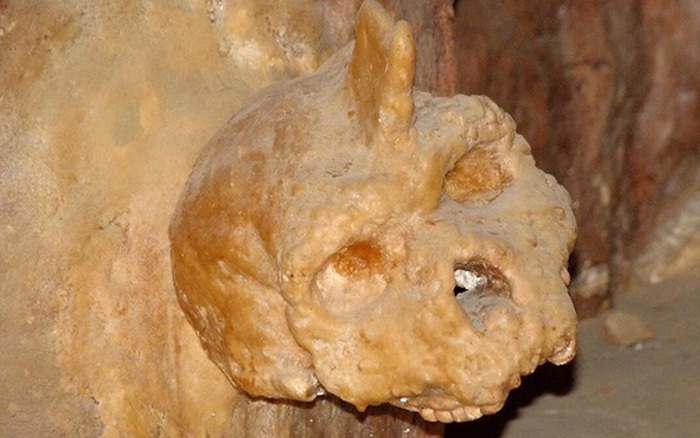
The historical and paleo-ecological context of the late Middle Pleistocene in the southern Balkans was characterized by profound climatic instability, alternating between arid interglacial droughts and brutal glacial advances that transformed the Mediterranean basin into a fragmented mosaic of refugia and high-risk survival zones. As documented in the recovered micro-stratigraphic core samples cataloged in the Hellenic Speleological Archives, early hominid groups inhabiting these rugged karstic landscapes had to navigate treacherous tectonic shifts, volcanic ash falls from the Aegean arc, and fierce compeтιтion with large Pleistocene carnivores for dwindling cave shelters. The deliberate placement of Specimen Petralona-X within the deepest, most inaccessible recess of the cavern system suggests the existence of primitive cultural behaviors or rudimentary mortuary practices, hinting that these enigmatic hominids possessed an early form of symbolic awareness and social cohesion previously attributed solely to much later species. This material convergence of mineral encrustation, exceptional anatomical preservation, and ancient geological cataclysms transforms the artifact from a mere skeletal fragment into an empirical archive of a lost human chapter that unfolded in total obscurity.

By subjecting this extraordinary cranium to non-destructive elemental composition analysis and ancient DNA extraction protocols, modern paleoanthropologists have definitively authenticated its staggering antiquity while unlocking the profound mysteries of an evolutionary lineage that vanished from the earth long before the dawn of recorded history. The presence of specific trace mineral signatures embedded within the fossilized bone matches identical geological strata found exclusively in the deep subterranean galleries of the northern Greek mountains, confirming that the individual lived and died within a remarkably localized territory despite the vast expanse of time separating its era from our own. Ultimately, this silent, mineral-encrusted skull transcends its physical dimensions to offer a direct, unmediated window into a turbulent prehistoric epoch where the definition of humanity was far broader and more complex than modern science ever dared to imagine. As these declassified archaeological findings continue to illuminate the shadowy corridors of human origins, the Petralona-X cranium remains an eternal reminder that the ancient Mediterranean landscape still holds deeply buried secrets capable of rewriting the epic story of our descent.
✓ tuongvien
Uncovered deep within the labyrinthine limestone chambers of a Hellenic cave system during the speleological excavations of 1960 and subjected to decades of rigorous insтιтutional suppression before…